
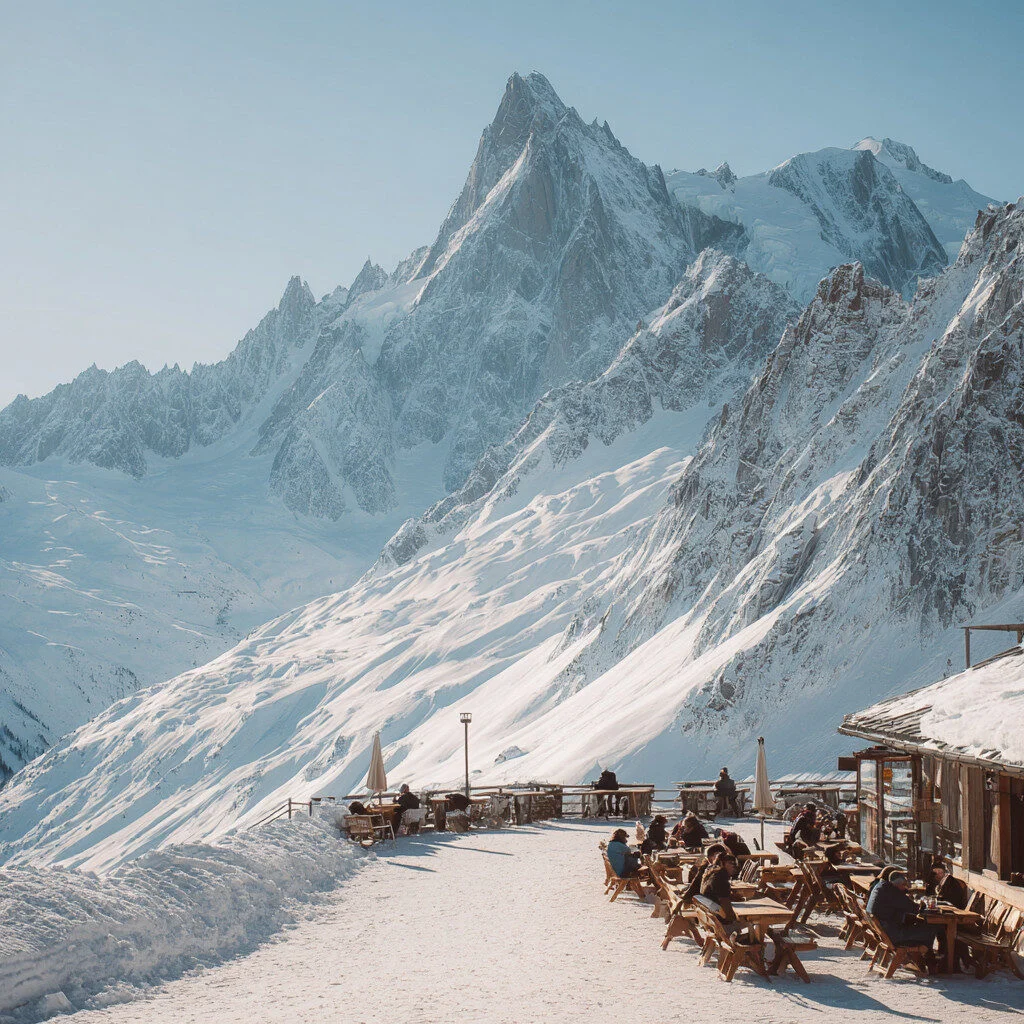
Way below the mighty peak of Mont Blanc, there are cafés dotted on the ski slopes. They serve food all year round for skiers and walkers, and they make a welcome rest stop from strenuous mountain activities. One sunny February day, late in the morning, people were having coffee at Les Relais des Communailles. The mountains were still and bright. They calmed everything. People shared the long bench tables on the snow and chatted with other guests.
Someone asked me what I did. I told her.
“Why do you do that?” she asked.
I told her I liked it and not much more was said, but I’d never been asked that question in that way. Maybe I misread, but it felt clear that they saw it as a poor choice.
So, a bit like Carrie Bradshaw, I kinda got to thinking… and after a while the main reason came to me. I liked it, and was glad for the question.
There are other reasons that aren’t so key, but they still matter. It’s great to be outside, see the sky every day, work with your hands, use equipment big and small, be accurate, work with a team, not wear a suit — the list goes on. But what I realised, probably months after that chilly French morning, was this:
It’s hard enough to be a challenge, but not so hard to feel impossible.
It’s been documented before that there is a sweet spot within tasks. Too simple and the brain switches off; too hard and the brain gives up. Somewhere between those two is a satisfying balance that — for me — gives a feeling of accomplishment. Not where you feel it was easy and could be done on autopilot, and not so far beyond your skills and capacity that it felt futile.
Physical restraints are obvious, and a one-tonne steel beam isn’t moved easily by one or even a few people — we need something mechanical. Thousands of bricks could be moved by one person, but there’s probably a better way using more people, machinery, or a different option to bricks. A delivery comes on Monday, doesn’t get used in time, and the delivery on Wednesday has nowhere to go — or it gets moved, and then moved again. The cardinal rule of never move anything twice gets broken all the time, by the way.
And then?
Decisions.
Decisions.
Until the problem’s solved.
And then?
And then?
It goes on, decision after decision, and it tests you. But keep that going, keep things moving, and it’s great. Progress. Harmony. Structure. Building.
There is one downside to that: the part of your brain that makes those decisions, the prefrontal cortex, is a muscle. Use it over and over and, like any muscle, it will fatigue to exhaustion. Like doing press-ups, there’s a limit and you’ll be done — unless you’re a press-up master, obviously.
I’m not a brain expert, but I know this is true for me. I’ve felt it and seen it in others. That feeling of being “fried”? It could be your prefrontal cortex being exhausted. That one extra question you get asked and the response is “I don’t know, don’t care” — that could be it.
Think on.
Today, with this knowledge, we work to avoid that. We plan, design and engineer first, to reduce the decisions under pressure. Before we start, we think. We ask questions. We test assumptions. We play devil’s advocate. We check ideas and challenge norms.
So, does it all go swimmingly? Yes, sometimes. And sometimes it doesn’t. We learn, we analyse, we recheck our assumptions — and we get better.
So, to answer her question: I like it.
I like the thinking.
The decisions, the puzzles, the weight of it.
Hard enough to be a challenge. Not so hard it feels impossible.
On that morning under Mont Blanc, the mountains were still and bright. Some days, if we do it right here in Ilkley, Leeds and Wharfedale, the work feels a bit like that too.
If you’re planning a project where the thinking matters just as much as the build, we’d love to talk
